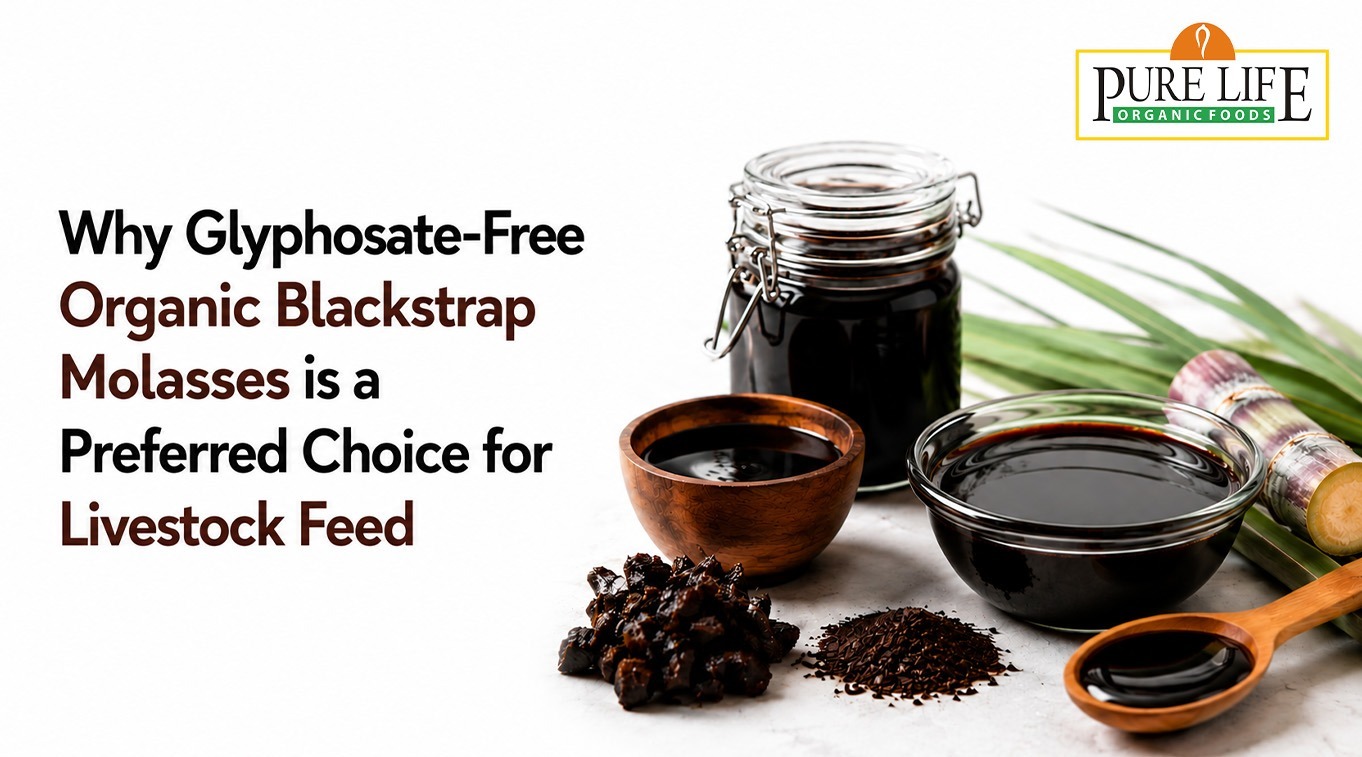
Selecting a livestock feed ingredient may appear straightforward, as the basic objective is usually to provide energy, improve ration acceptance, and help livestock utilise the available feed effectively. However, modern feeding decisions are no longer restricted to nutrient value alone. Farmers and feed manufacturers also want to know how an ingredient is produced and whether unwanted chemical residues may enter the feeding programme.
This is precisely where glyphosate-free organic blackstrap molasses gains significance. Molasses has long been used in livestock nutrition because of its fermentable sugars, mineral content, palatability, and handling properties. But what happens when these qualities are combined with certified organic processing and freedom from synthetic pesticides, herbicides, chemical residues, and harmful clarifying agents? Let us understand why the distinction matters.
Pure Life manufactures its molasses through certified organic processing. According to the approved client information, the product has zero contaminants in the form of synthetic pesticides, herbicides, or chemical residues, and the process avoids harmful clarifying agents. Therefore, the focus extends beyond the finished product to the way it is manufactured.
Why Is Molasses Widely Used In Livestock Feed?
Research describes molasses as an energy feedstuff containing easily fermentable sugars (while its sweetness and binding properties make it useful across several feeding systems). According to the client information, approximately 99% of production is used for livestock feed, clearly reflecting its practical importance. When incorporated appropriately, molasses can:
- Supply readily available energy through sugars and carbohydrates.
- Improve the taste of less appealing feed and encourage ration acceptance.
- Reduce dust in dry feed mixtures and help bind ingredients together.
- Support the utilisation of coarse or lower-quality forage.
However, more is not necessarily better. Scientific literature makes it clear that results depend on inclusion level, ration composition, livestock type, and production stage.
A Useful Combination Of Energy And Minerals
Feed efficiency depends on much more than a single nutrient. This molasses is particularly interesting because it combines fermentable sugars with naturally occurring minerals.
The approved information highlights calcium, iron, potassium, magnesium, manganese, and copper. These minerals add nutritional value, but they must still be assessed as part of the complete ration. Research stresses the need to balance energy, protein, minerals, fibre, and other nutrients rather than treat molasses as a complete feed.
Pure Life manufactures the product as a high-energy, mineral-containing feed ingredient. Molasses performs its intended role most effectively when incorporated into a properly formulated livestock diet.
How Can It Support Rumen Function And Feed Efficiency?
In ruminants, easily fermentable sugars can provide energy for rumen microorganisms when the overall ration is appropriately balanced. Research indicates that moderate molasses use may support rumen fermentation, microbial activity, fibre digestion, and microbial protein synthesis.
The research also discusses improved utilisation of coarse forage and greater dry matter intake under certain feeding conditions. Better ration acceptance and reduced sorting may help animals consume the feed more consistently. Molasses-based feeding systems may additionally support:
- Improved palatability and more uniform ration consumption.
- Reduced feed dust, particularly in dry mixtures.
- Better management of coarse or less desirable feed ingredients.
- Nutritional strategies during early lactation, when ketosis risk requires attention, and during periods of heat stress.
These are not standalone outcomes. Water availability, mineral balance, forage quality, housing, and the wider feeding programme remain equally important.
Practical Applications On The Farm
Molasses can be mixed gradually into a total mixed ration, or TMR, to improve uniformity, reduce dust, and limit feed sorting. It may also be used as a top-dressing to make the ration more appealing.
Liquid feeders provide another application because molasses can act as a base for suitable liquid feed components. During silage preparation, its soluble sugars may encourage lactic fermentation and faster pH reduction under suitable ensiling conditions.
Premium companies like Pure Life supplies feed-grade molasses in commercial formats (including tanker trucks, flexi bags, barrels, and IBC tanks). Since the company is a manufacturer rather than a sourcing or trading business, its positioning remains closely connected with production.
Final Overview
Selecting a livestock feed ingredient is not merely about adding another source of energy. Its production method, composition, compatibility with the ration, and practical farm application all deserve attention.
Glyphosate-free organic blackstrap molasses brings together fermentable energy, mineral content, palatability, dust control, and feeding flexibility. It can be incorporated into TMR, top-dressing, liquid feeders and silage, while research supports its broader role in rumen fermentation and feed utilisation when used appropriately.
Thus, for livestock operations seeking a carefully manufactured ingredient with practical feeding applications, glyphosate-free molasses can become a relevant addition to a well-balanced feeding programme.
FAQs
Why Is Glyphosate-Free Molasses Preferred For Livestock Feed?
Glyphosate-free molasses gives buyers greater assurance regarding unwanted agricultural residues.
Can Molasses Be Added Directly To A TMR?
Yes, molasses can be incorporated gradually into a total mixed ration. It can improve uniformity, reduce dust, limit feed sorting, and make less appealing ingredients easier for livestock to consume.
Is Molasses Suitable For Silage Preparation?
Molasses can be useful in silage because its soluble sugars may encourage lactic fermentation and faster pH reduction. Its effectiveness depends on forage moisture, inclusion level and proper ensiling management.