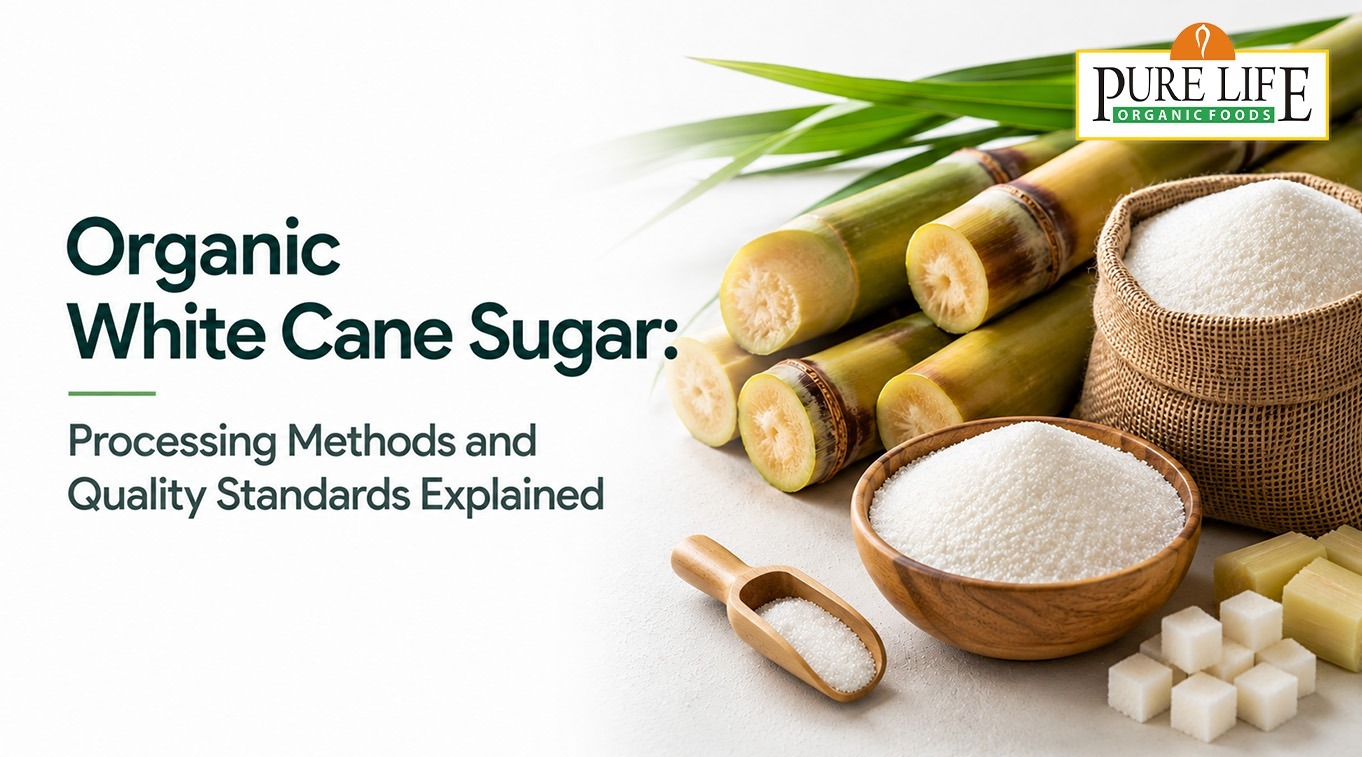
Choosing sugar for food production can appear simple, as most buyers focus on colour, sweetness and price. However, certified organic products require a closer look. The cultivation method, manufacturing process, clarification system, moisture level and final handling all influence quality. Therefore, understanding how Organic White Cane Sugar is processed can help buyers evaluate a product instead of judging it only by appearance.
Well, white cane sugar does not simply move from a sugarcane field into a finished bag. It passes through controlled manufacturing stages where unwanted matter is removed, sucrose is concentrated, and crystals are formed. Let us understand the process in a simple manner.
From Sugarcane To Clear Juice
The process starts with sugarcane being harvested and transported to the manufacturing facility. The cane is cleaned and crushed so that the juice can be extracted efficiently. This raw juice contains sugar along with water, fibres and other non-sugar components.
Clarification is the second step, where the undesired content is eliminated, and then concentration occurs. This is especially crucial in organic production since the procedure should be conducted in accordance with the relevant organic standards and should not use materials that are not allowed by the selected certification standard.
Pure Life positions itself as a manufacturer and highlights certified organic processing without harmful clarifying agents. This matters because buyers increasingly want to know not only what the final product looks like, but also how it has been manufactured.
How Concentration And Crystallisation Take Place
Once clarified, the juice is evaporated until it becomes a concentrated syrup. The process then moves towards crystallisation, where controlled conditions encourage sucrose to form crystals.
Several factors can influence this stage:
- Temperature must be controlled so that crystal formation remains consistent.
- The syrup must reach the correct concentration before crystallisation can progress.
- Crystal size and uniformity depend on careful processing and handling.
- Excess moisture must be reduced before packing and storage.
The crystals are then separated from the remaining syrup, dried and cooled. The objective is to achieve a clean and free-flowing product with consistent physical characteristics.
Why Organic Processing Standards Matter
Organic sugar is not defined only by the colour of its crystals. Agricultural inputs, permitted processing materials and manufacturing controls all contribute to the organic status of the finished product.
For a buyer, several questions deserve attention:
- Has the sugar been manufactured under a recognised organic certification system?
- Are synthetic pesticides, herbicides and unwanted chemical residues excluded from the approved production process?
- Are processing materials compatible with organic requirements?
- Is traceability maintained from raw material to finished product?
Pure Life emphasises zero contaminants within its approved product positioning, including the absence of synthetic pesticides, herbicides and chemical residues. For a manufacturer, such controls matter because quality must be established throughout the production chain.
What Determines The Quality Of White Cane Sugar?
Quality standards usually examine physical, chemical and operational characteristics. A bright appearance may be useful, but it cannot be the only measure. Buyers must also consider purity, moisture control and consistency.
Colour reflects how effectively colour-forming substances have been managed during processing, while crystal size matters for users who require consistent dissolution and mixing. Excess moisture can affect flow, storage and the tendency of sugar to form lumps.
Purity and sucrose content are equally significant because a controlled product should deliver predictable performance across batches. Foreign matter, unusual odours and visible contamination are obvious quality concerns.
Testing, Traceability, and Batch Consistency
A quality standard becomes meaningful only when it can be measured and repeated. Manufacturers therefore rely on sampling, testing and documentation. Depending on buyer requirements, checks may cover colour, moisture, sucrose, ash and crystal characteristics.
Traceability is equally important because a manufacturer should be able to connect the finished batch with relevant production records. Pure Life, being a manufacturer rather than a sourcing or trading company, can present its production approach directly and keep the discussion centred on processing controls.
Storage And Handling After Production
Even properly manufactured sugar can lose some of its desired physical qualities under poor storage conditions. Therefore, it should be kept in a clean and dry place, protected from water, excessive humidity, contamination and strong surrounding odours. Packaging should also remain intact.
Conclusion
Sugarcane to Organic White Cane Sugar is a much longer Organic White Cane Sugar process than crushing, boiling and packing. Final quality is achieved through clarification, evaporation, crystallisation, drying, testing, traceability and storage. Organic production is an added burden since the inputs that are allowed and certified processing systems should be taken into account during the production process.
To the buyers, the logical thing to do is to consider the product specification as well as the manufacturing process. Pure Life is a company that positions itself as a producer of certified organic processing and controlled production, and transparency in the processes is a significant component of the overall product discourse.
FAQs
What Is The Difference Between Organic And Conventional White Cane Sugar?
The main difference lies in the production system. Organic sugar must follow approved cultivation and processing requirements, while conventional sugar may use agricultural or processing inputs that are not permitted under organic standards.
Why Is Clarification Important In Cane Sugar Processing?
Clarification removes suspended and unwanted matter from raw cane juice before concentration. A controlled clarification stage supports cleaner processing, more consistent crystallisation and better management of the final sugar’s appearance and purity.
Which Quality Checks Are Commonly Considered For White Cane Sugar?
Buyers generally examine colour, moisture, sucrose purity, crystal consistency, foreign matter, odour and packaging condition. Depending on the intended application, manufacturers may also follow additional technical specifications and documented testing requirements.