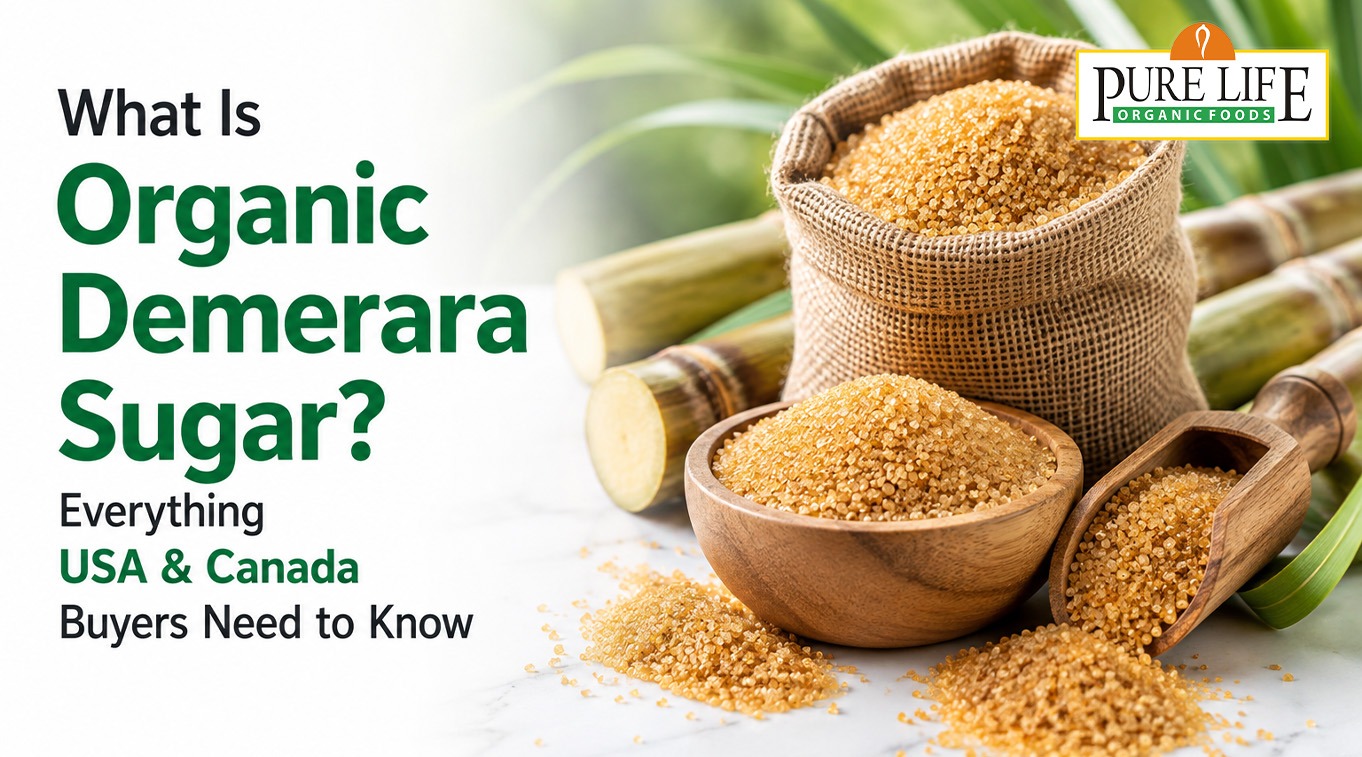
Have you ever noticed those large, golden-brown sugar crystals used on cookies, pastries, beverages, or specialty food products? The first question that comes to mind is what makes this sugar different from the regular white or brown sugar we commonly use. Well, this is where Demerara sugar comes into the picture.
For food businesses and ingredient buyers across the USA and Canada, sugar selection is not always limited to sweetness. Crystal size, color, flavor, processing method, organic certification, and intended application can all influence the buying decision. Hence, understanding Organic Demerara Sugar can be useful before selecting it for a particular food or beverage application.
What Exactly Is Organic Demerara Sugar?
Demerara sugar is generally recognized by its relatively large crystals and characteristic golden to light brown appearance. It is produced from sugarcane and retains some of the naturally occurring molasses characteristics that contribute to its color and flavor.
The organic type is made in line with the relevant organic production and processing standards. In the case of commercial purchasers, the organic label is especially applicable in the creation of products that are supposed to comply with certain organic labeling or ingredient standards.
How Is It Different From Regular White Sugar?
You must be wondering why a manufacturer would choose Demerara sugar when conventional white sugar is readily available. The answer mainly comes down to the characteristics required in the finished product.
White sugar is highly refined and generally has small, uniform crystals with a neutral sweetness. Demerara sugar, on the other hand, typically has larger crystals, a golden-brown appearance, and subtle molasses-like notes.
Hence, the choice between the two may depend on whether sugar needs to simply provide sweetness or also contribute texture, appearance, and a particular flavor profile.
What Makes The Crystal Structure Important?
One of the most noticeable features of Organic Demerara Sugar is its crystal structure. Its coarse crystals can remain more noticeable than finer sugar varieties in certain applications.
For example, when sprinkled over muffins, cookies, scones, or other baked products before baking, the crystals may provide a distinctive surface appearance and texture. This characteristic can also make Demerara sugar relevant for products where the sugar itself forms part of the visual presentation.
What Does Demerara Sugar Taste Like?
Despite its main purpose of being sweet, Demerara sugar tends to provide a greater flavor depth than extremely refined white sugar. Its light molasses and caramel-like flavors can be used to supplement dishes in which a slightly darker sugar profile is desired.
However, it is important to remember that formulation requirements differ considerably between products. Food manufacturers may therefore need to evaluate sweetness, moisture, crystal size, flavor, and other formulation factors before determining the appropriate quantity.
Where Can Organic Demerara Sugar Be Used?
This is perhaps one of the most important questions for commercial buyers. Demerara sugar can fit into several food and beverage categories, depending on the formulation and processing requirements.
Common applications may include:
- Bakery products such as cookies, muffins, cakes, and scones
- Toppings for baked goods and specialty desserts
- Coffee, tea, and other beverages
- Confectionery formulations
- Sauces, glazes, and selected marinades
- Specialty and organic packaged food products
Its combination of sweetness, larger crystals, color, and mild molasses notes gives manufacturers several possibilities when developing or modifying formulations.
Why Are Organic Credentials Important For Buyers?
When buying an organic ingredient, the word “organic” should not be viewed simply as a product description. Buyers generally need appropriate documentation and certification to support their own procurement, manufacturing, and labeling requirements.
This is especially vital to USA and Canada consumers when ingredients are to be used in certified organic product lines. The import requirements, certification equivalency, documentation, and relevant labeling regulations might also be reviewed based on the targeted market and product category.
What Should USA And Canada Buyers Check Before Ordering?
Buying ingredients commercially involves considerably more than comparing prices. The first thing which buyers may want to establish is whether the product specifications match their manufacturing requirements.
Some of the factors that can be discussed with the manufacturer include crystal size, color, moisture specifications, packaging formats, organic certification, production standards, traceability, minimum order quantities, and logistics requirements.
Buyers might also require documentation that is pertinent to their quality assurance and regulatory procedures. Before ordering, it can be much easier to clarify these requirements and plan procurement and production.
Does Packaging Matter For Bulk Orders?
Yes, particularly when sugar will travel through an international supply chain or remain in storage before manufacturing.
Commercial packaging needs may vary according to order quantity, handling systems, transportation, warehousing conditions, and how the ingredient will eventually enter the production line. Hence, buyers should discuss available packaging formats and shipment requirements directly with the manufacturer rather than assuming that one packaging option will suit every operation.
Why Does Manufacturer Selection Matter?
Ingredient consistency can play an important role in commercial food production. When a formulation depends on specific crystal, color, flavor, or processing characteristics, variations between batches may influence the manufacturing process or finished product.
This is why buyers may consider factors beyond the ingredient itself. Manufacturing capabilities, quality systems, certification, documentation, traceability, packaging, and communication can all form part of supplier evaluation.
Choosing Organic Demerara Sugar For Your Business
So, is Organic Demerara Sugar suitable for your food or beverage operation? This is largely based on your formulation, crystal properties you desire, flavor profile, certification requirements, packaging requirements, and your target market.
Purelife manufactures high-quality organic sugarcane products for commercial and industrial applications. We work with businesses and buyers looking for certified organic ingredients that meet their specific sourcing and market requirements. . Purelife can be contacted by companies in the USA and Canada that are considering Demerara sugar as a product line and negotiate specifications, manufacturing, packaging, documentation, and commercial supply requirements.
Frequently Asked Questions
- Does Demerara sugar equal brown sugar?
Not exactly. Demerara sugar is typically coarser-grained and of a golden-brown color. However, the products labeled as brown sugar may vary in the size of the crystal, water content, molasses content, and method of production.
- Is Demerara sugar suitable in commercial baking?
Yes, it can be used in commercial baking, such as in recipes where bigger crystals, surface texture, sweetness, or light molasses-like flavors are required. It will be based on the personal development and production process to identify its appropriateness.
- What do bulk buyers demand prior to buying?
Business clients may want to view product specifications, organic certification, quality documentation, packaging options, traceability information, minimum order and shipping requirements before they make an order.